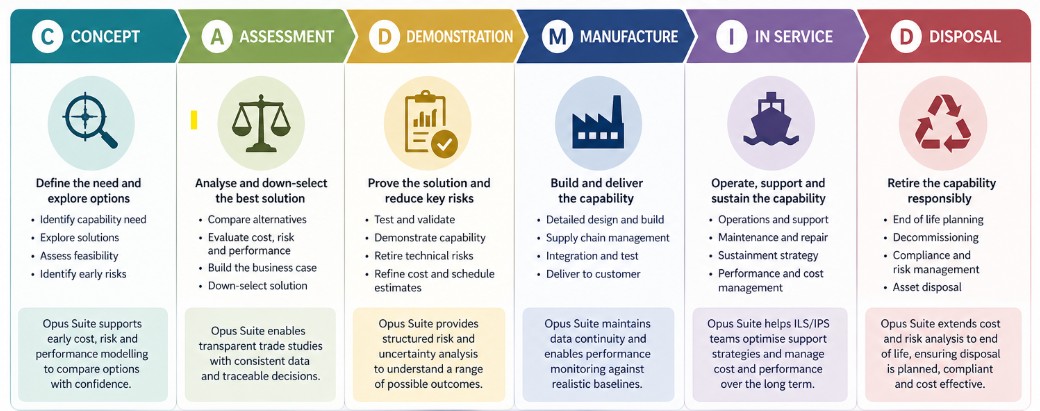

CADMID (Concept, Assessment, Demonstration, Manufacture, In-Service, and Disposal)
In UK Ministry of Defence programs, CADMID is the standard framework used to structure how capabilities are conceived, delivered, supported, and ultimately retired. While it is often presented as a sequence of phases, its real value lies in how it connects decisions across the full lifecycle.
The CADMID cycle is the standard lifecycle framework used by the UK Ministry of Defence (CDPUSR in NATO) to manage complex programs from initial concept through to disposal. While often presented as a structured sequence of phases, its real importance lies in how it shapes decision making across the entire lifecycle.
For organizations working in defense, aerospace, and other complex asset environments, understanding CADMID is not just about knowing the phases. It is about understanding where risk is introduced, how cost is committed, and how early decisions influence long term outcomes.
What is the CADMID cycle
CADMID stands for Concept, Assessment, Demonstration, Manufacture, In Service, and Disposal. It provides a structured approach to managing capability development and support across the full lifecycle.
Each phase has defined objectives, decision points, and assurance requirements. Together, they create a framework that allows programs to be planned, reviewed, and governed in a consistent way.
However, CADMID is not just a process. It is a decision framework. The real value comes from how effectively organizations use it to connect technical, operational, and financial decisions over time.
Why the CADMID cycle matters
In large defense programs, the majority of lifecycle cost and performance is determined early, often before systems are built or deployed.
Decisions made in the Concept and Assessment phases influence:
- Long term cost of ownership
- System availability and readiness
- Maintenance and support requirements
Risk exposure across the lifecycle
If these decisions are based on incomplete or inconsistent data, the consequences typically appear later as cost overruns, reduced performance, or operational constraints.
This is why modern approaches to CADMID increasingly focus on data driven decision support rather than process compliance alone.
The six phases of the CADMID cycle
Concept
The Concept phase defines the capability need and explores potential solutions. At this stage, uncertainty is high, but decisions have the greatest long term impact.
Key activities include:
- Identifying operational requirements
- Exploring solution options
- Developing early cost estimates
Highlighting major risks
The challenge is that decisions must be made with limited data. A structured analytical approach helps ensure that early assumptions are realistic and comparable.
Assessment
During Assessment, options are analyzed in more detail and down selected to a preferred solution.
This phase focuses on:
- Developing the business case
- Comparing trade offs between cost, performance, and risk
- Refining assumptions and requirements
In practice, these decisions are often fragmented across teams. Bringing data together into a consistent model allows trade offs to be understood more clearly and justified more effectively.
Demonstration
The Demonstration phase aims to prove that the selected solution is viable and that key risks have been reduced.
Typical activities include:
- Testing system performance
- Validating design assumptions
- Reducing technical and operational risk
If risks are not fully understood here, they tend to reappear later as delays or cost increases. This makes structured risk and uncertainty analysis essential.
Manufacture
Manufacture is where the system is built and delivered. At this point, many earlier decisions become fixed.
Key considerations include:
- Production efficiency
- Cost and schedule control
- Alignment with design assumptions
Maintaining consistency between earlier models and actual performance is critical to avoid disconnects between expectation and reality.
In Service
The In Service phase covers operation, maintenance, and sustainment. This is typically the longest and most expensive phase of the lifecycle.
Outcomes here are heavily influenced by earlier decisions around:
- Reliability and maintainability
- Support strategies
- Inventory and resource planning
Organizations that invest in understanding these relationships early are better positioned to achieve high availability at controlled cost.
Disposal
Disposal involves decommissioning, regulatory compliance, and asset retirement.
Although often overlooked, this phase can carry significant cost and risk. Decisions made earlier in the lifecycle can greatly influence how complex and expensive disposal becomes.
Including disposal considerations early improves long term planning and reduces surprises at end of life.
CADMID is a connected lifecycle
While CADMID is often shown as a sequence of phases, it is better understood as a connected lifecycle.
Decisions made in early phases shape outcomes decades later. At the same time, data from in service operation should inform future programs and updates.
The challenge for many organizations is that information is fragmented across tools, teams, and phases. This leads to inconsistent assumptions and limited visibility into how decisions are linked.
Enabling better decisions across CADMID
To fully realize the value of the CADMID framework, organizations need a way to connect cost, risk, and performance across all phases.
This is where model based approaches and integrated analytical environments such as Systecon's Opus Suite+ play an important role.
By combining simulation, optimization, and lifecycle cost analysis, it becomes possible to:
- Evaluate decisions consistently from concept through to disposal
- Understand trade offs between cost, readiness, and risk
- Maintain traceability of assumptions across phases
- Support more transparent and defensible decision making
Rather than treating each phase in isolation, this approach enables a continuous view of the lifecycle.
Conclusion
The CADMID cycle provides a powerful framework for managing complex defense programs, but its value depends on how it is used.
Organizations that treat CADMID as a checklist may achieve compliance. Those that use it as a decision framework, supported by data and analysis, are more likely to achieve better outcomes.
As programs become more complex and expectations increase, the ability to connect decisions across the lifecycle is becoming essential. CADMID provides the structure. The advantage comes from how effectively that structure is used.
Frequently asked questions
What does CADMID stand for?
CADMID stands for Concept, Assessment, Demonstration, Manufacture, In-Service and Disposal. It is the standard lifecycle framework used by the UK Ministry of Defence to manage capability programmes from initial concept through to retirement.
Is CADMID a strictly linear process?
No. CADMID is often presented as a sequence of six phases, but in practice it functions as a connected lifecycle rather than a checklist. Decisions made in the Concept and Assessment phases shape outcomes decades later, and data from In-Service operation should feed back into future programmes and updates.
How does CADMID relate to NATO's framework?
CADMID is the UK MOD's national implementation of the lifecycle approach used across NATO, where the equivalent framework is referred to as CDPUSR. Both structure capability delivery around the same underlying principle: connecting technical, operational and financial decisions across the full life of a system.
Which CADMID phase has the greatest influence on lifecycle cost?
The Concept and Assessment phases. The majority of a programme's lifecycle cost and performance is determined early, often before a system is built or deployed, which is why decisions made under uncertainty in these phases carry disproportionate long-term weight.
Which CADMID phase is typically the longest and most expensive?
In-Service. It covers operation, maintenance and sustainment, and its outcomes, availability and cost are heavily influenced by reliability, maintainability and support decisions made in earlier phases.
Why is the Disposal phase often overlooked?
Disposal involves decommissioning, regulatory compliance and asset retirement, and it typically receives less attention than earlier phases because its cost and complexity are less visible upfront. Decisions made much earlier in the lifecycle can significantly increase the cost and risk of disposal, which is why it needs to be considered from the Concept phase onward rather than left until end of life.
What is the difference between following CADMID as a process and using it as a decision framework?
Treating CADMID as a checklist achieves compliance with defined objectives and assurance requirements at each phase. Using it as a decision framework means connecting cost, risk and performance data across all six phases so that trade-offs are understood consistently and decisions remain defensible over time. This is what determines whether programmes actually achieve better outcomes.
Why does data consistency matter across the CADMID phases?
Information is often fragmented across tools, teams and phases, which leads to inconsistent assumptions and limited visibility into how early decisions connect to later results. A consistent, model-based view allows trade-offs between cost, readiness and risk to be evaluated on the same basis from Concept through to Disposal.
How does Opus Suite+ support organisations working within the CADMID cycle?
Opus Suite+ combines simulation, optimisation and lifecycle cost analysis in a single environment, allowing organisations to evaluate decisions consistently across all CADMID phases, understand trade-offs between cost, readiness and risk, and maintain traceability of assumptions from Concept through to Disposal.
Who uses the CADMID framework?
CADMID is used primarily within UK Ministry of Defence programmes, but the underlying approach applies to any organisation managing complex, long-lived assets in defence, aerospace and similar sectors where early decisions have long-term cost and readiness consequences.
Related Articles
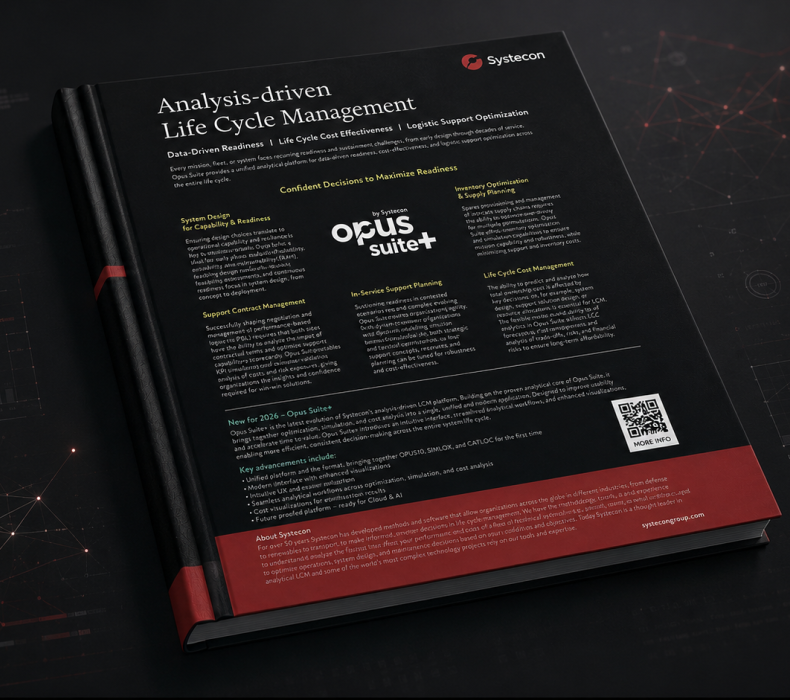
Discover The Latest Release of Opus Suite+
Opus Suite+ unifies the proven capabilities of OPUS10, SIMLOX, and CATLOC in a single modern platform, delivering fast, accurate analysis, optimization, and simulation across your system’s entire life cycle. Download the product overview to find out more.
Now with its second release, Opus Suite+ is not only a full replacement for OPUS10 and SIMLOX – it takes a significant step beyond.

Explore Opus Suite+
The modern evolution of analysis-driven Life Cycle Management
Opus Suite provides the advanced analytical capabilities that organizations rely on to make informed, data-driven decisions across the entire system life cycle. From concept and development through to operations and sustainment, it enables powerful modelling, simulation, and optimization to manage cost, performance, and readiness.
Opus Suite+ brings these proven capabilities together in a unified, modern application, combining OPUS10, SIMLOX, and CATLOC into a single environment. With an intuitive interface, streamlined workflows, enhanced visualizations, and AI and cloud-enabled capabilities, it delivers an improved user experience and more efficient, consistent analysis across the system life cycle.
Designed to help organizations manage complexity and act with confidence, Opus Suite+ enables better decisions, faster.