Life Cycle Management (LCM)
Life Cycle Management (LCM) is the strategic discipline underpinning integrated logistics support. Opus Suite+ is the world's leading Life Cycle Management (LCM) software, designed to help organizations achieve required performance and availability at minimum lifecycle cost. By unifying spare parts optimisation, operational simulation, and cost analysis in a single platform, Opus Suite+ replaces fragmented approaches with coherent, data-driven decision-making.
Life Cycle Management as a Strategic Discipline
Life Cycle Management is often misunderstood as a maintenance or asset management activity. In reality, it is far broader. LCM is a strategic framework that connects engineering design, procurement strategy, logistics planning, operational performance, and financial forecasting.
The central principle is straightforward: decisions made early in a system’s lifecycle have disproportionate long-term consequences. Acquisition cost typically represents only a fraction of total life cycle cost. The majority of expenditure occurs during operations and sustainment. Effective Life Cycle Management therefore shifts focus from short-term budgeting to total cost of ownership and long-term availability.
By aligning technical and financial perspectives, organizations can avoid sub-optimization and manage complex systems with clarity and foresight.
Managing the Full Lifecycle
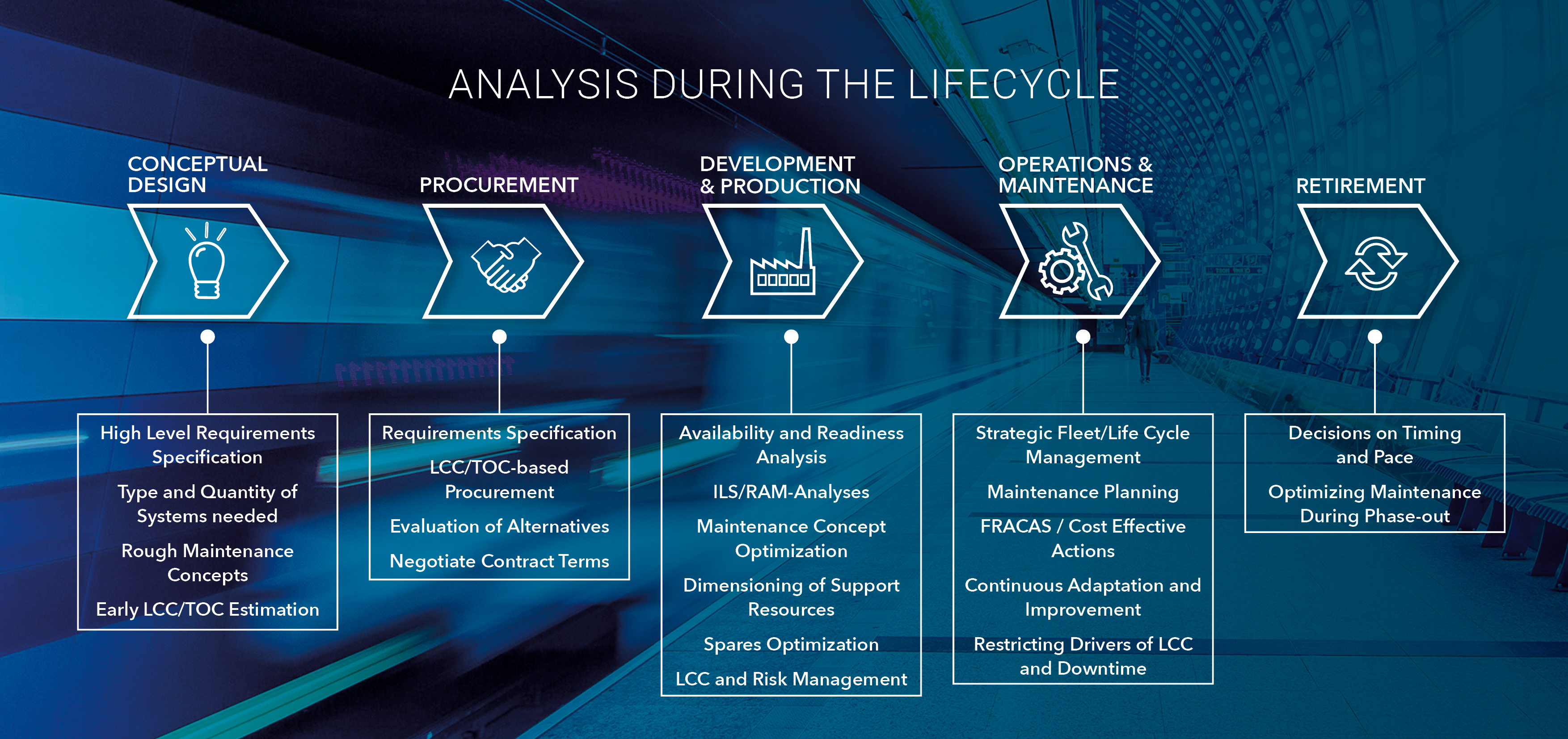
Life Cycle Management spans five interconnected phases — each influencing the next.
Conceptual Design
The conceptual phase defines requirements, performance expectations, and early architectural choices. At this stage, uncertainty is high but influence is greatest. Strategic trade-off analysis, preliminary life cycle cost modelling, and early maintenance concept development are critical.
Organizations that apply structured Life Cycle Management in this phase gain visibility into future sustainment costs before major commitments are made. This is where long-term affordability and readiness are shaped.
Procurement
Procurement decisions determine not only what is purchased, but how risk and responsibility are allocated across the lifecycle.
A Life Cycle Management approach to procurement evaluates alternatives based on total cost of ownership, performance under uncertainty, and long-term support implications. It integrates cost modelling, availability analysis, and contract structuring to ensure that incentives align with lifecycle performance.
When procurement is driven by acquisition price alone, downstream sustainment costs often escalate. LCM prevents this by embedding lifecycle thinking into supplier evaluation and negotiation.
Development and Production
During development and production, systems must be engineered for reliability, maintainability, and supportability. Availability and readiness are not operational outcomes alone — they are design characteristics.
Life Cycle Management in this phase relies on reliability, availability, and maintainability (RAM) modelling, integrated logistics support (ILS) analysis, maintenance concept optimization, and spare parts dimensioning. These analyses quantify how design decisions will influence long-term cost, downtime, and support resource requirements.
The objective is to ensure that operational performance is predictable and economically sustainable before systems enter service.
Operations and Maintenance
For most complex systems, the operational phase represents the longest and most cost-intensive stage of the lifecycle. This is where Life Cycle Management becomes continuous performance management.
Operational LCM integrates maintenance planning, fleet strategy, cost driver analysis, and failure data evaluation. By combining performance data with probabilistic cost modelling, organizations can optimize maintenance intervals, prioritize corrective actions, and manage uncertainty in long-term budgets.
Rather than reacting to failures, Life Cycle Management enables proactive control of availability and cost.
Retirement and Phase-Out
Life Cycle Management does not end when systems approach obsolescence. Decisions regarding life extension, replacement timing, and phase-out maintenance strategies can significantly affect long-term expenditure and operational risk.
Structured lifecycle analysis helps organizations determine when continued sustainment becomes economically inefficient and when replacement yields greater value. Retirement decisions should be driven by data, not age alone.
Each phase requires rigorous analysis supported by life cycle management software. Early decisions about system design, support concepts, and spare parts strategies cascade through the entire lifecycle. Opus Suite+, the only platform that integrates OPUS10 (spare parts optimisation), SIMLOX (operational simulation), and CATLOC (cost analysis), enables coherent analysis from concept through retirement
The Role of Life Cycle Cost (LCC)
Life Cycle Cost analysis is a foundational component of Life Cycle Management. It quantifies all costs incurred across the lifecycle — acquisition, operations, maintenance, logistics support, upgrades, and disposal.
However, effective LCM goes beyond static cost aggregation. It incorporates uncertainty, variability, and risk. Modern lifecycle modelling uses probabilistic methods to simulate future performance and cost outcomes under different scenarios.
This approach enables decision-makers to compare alternatives not just on expected cost, but on risk exposure and long-term financial predictability.
Integrating Availability, Risk, and Cost
What distinguishes advanced Life Cycle Management from traditional asset planning is the integration of availability, cost, and risk into a unified analytical framework.
Availability targets influence maintenance strategies. Maintenance strategies influence cost. Cost uncertainty influences investment decisions. LCM recognizes these interdependencies and models them quantitatively.
By understanding these relationships, organizations can:
Increase operational readiness
Control life cycle cost drivers
Reduce financial uncertainty
Support strategic fleet planning
Strengthen long-term capital allocation decisions
In capital-intensive industries such as defense, rail, energy, and infrastructure, even marginal improvements in availability or sustainment efficiency can translate into substantial financial impact.
A Quantitative Approach to Decision Support
Modern Life Cycle Management relies on advanced simulation and decision-support tools rather than static spreadsheets. Monte Carlo simulation, scenario analysis, and sensitivity testing allow organizations to evaluate the consequences of decisions before they are implemented.
This quantitative approach transforms Life Cycle Management from a theoretical framework into a practical strategic capability. It enables informed trade-offs between cost, performance, and risk across decades of operation.
Life Cycle Management as Continuous Strategy
Life Cycle Management is not a one-time analysis performed at acquisition. It is an ongoing discipline that evolves with operational data, technological change, and strategic objectives.
Organizations that embed Life Cycle Management into governance processes gain long-term transparency and control over complex systems. They move from reactive maintenance and short-term budgeting to structured lifecycle optimization.
Ultimately, Life Cycle Management ensures that systems deliver sustained performance, predictable cost, and controlled risk — from concept to retirement.
Frequently Asked Questions
What is life cycle management (LCM) software?
Life Cycle Management (LCM) software provides a unified platform for planning, analysing, and optimising all aspects of system sustainment—from spare parts provisioning and maintenance strategies to lifecycle cost modelling and operational readiness. Unlike fragmented spreadsheet-based or point-tool approaches, modern LCM software integrates analysis, simulation, and cost modelling to ensure coherent decision-making across the entire support system. Opus Suite+ is the leading platform in this category, combining three proven capabilities—spare parts optimisation (OPUS10), operational simulation (SIMLOX), and lifecycle cost analysis (CATLOC)—into one unified system.
How does Opus Suite+ differ from legacy tools like OPUS10 or SIMLOX?
OPUS10 and SIMLOX are proven point tools that excel at specific tasks—OPUS10 in spare parts optimisation, SIMLOX in operational simulation. Opus Suite+ unifies these alongside cost analysis (CATLOC) in a single integrated platform with a modern interface, AI-enabled workflows, and cloud capabilities. The key difference: instead of moving data between separate tools, Opus Suite+ enables seamless workflows where spare parts decisions inform simulation models, which in turn drive cost predictions. Analysis, simulation, and cost modelling inform each other, not compete for attention.
What is the main advantage of life cycle management software?
The central advantage is eliminating the fragmentation that comes with multiple tools or spreadsheets. Life cycle management software ensures a single authoritative view of your programme's support strategy, cost drivers, and readiness constraints. Early decisions have disproportionate long-term impact—60–70% of total lifecycle cost is incurred in operations and sustainment, not acquisition. An integrated platform lets you model and optimise these decisions together, avoiding sub-optimal trade-offs that occur when cost, sparing, and availability are analysed in isolation.
Why should defence programmes use life cycle management software?
Defence and capital-intensive programmes face acute pressures: marginal improvements in availability translate to significant operational advantage and substantial cost savings. A mature LCM platform lets programme teams predict the consequences of design and support decisions before committing—test supply chain strategies, evaluate maintenance concepts, and compare support alternatives without guesswork. Trusted by the majority of NATO defence forces on programmes including F-35, GCAP, Type 26, and Queen Elizabeth-class carriers, life cycle management software has become the standard for high-stakes programmes where readiness and cost control are non-negotiable.
Can Opus Suite+ replace our current mix of tools?
Yes. Opus Suite+ is designed as a full replacement for organisations currently using OPUS10, SIMLOX, CATLOC, or a combination of legacy and custom-built tools. It consolidates spare parts dimensioning (OPUS10), logistics simulation (SIMLOX), and lifecycle cost analysis (CATLOC), plus new capabilities like AI-accelerated modelling, improved comparison workflows, and cloud-enabled collaboration. Migration from legacy tools is supported; many organisations have successfully unified their sustainment analysis within Release 2.
What makes Opus Suite+ the best life cycle management software?
Opus Suite+ is the world's only unified platform that integrates spare parts optimisation, operational simulation, and lifecycle cost analysis—the three pillars of life cycle management. It is trusted by the majority of NATO's defence forces and used on the world's most complex programmes. Release 2 introduces a modern, intuitive interface; faster search and analysis; smarter error detection; and seamless workflows between graphs, tables, and simulation results. No other LCM platform offers this depth of integration, breadth of capability, or proof of scale.
How does life cycle management software reduce lifecycle costs?
LCM software reduces O&S costs—which typically represent 60–70% of total lifecycle cost—by enabling data-driven decisions across four interdependent areas: technical performance, availability, process efficiency, and cost (the ASOE framework). By modelling spare parts strategies alongside maintenance concepts and availability targets, LCM software eliminates costly iterations and reveals true cost drivers. Early in the acquisition lifecycle, integrated analysis prevents downstream support surprises. During sustainment, it continuously optimises support strategies to maintain readiness at minimum cost.
Is Opus Suite+ suitable for programmes beyond defence?
Yes. While proven on defence programmes (F-35, Type 26, GCAP, QE-class carriers), Opus Suite+ is equally applicable to civilian asset-intensive sectors—rail, aviation, energy, marine. Any organisation managing complex systems over 10–50 year lifecycles where availability and cost control are critical benefits from life cycle management software. The ASOE framework and lifecycle cost analysis principles apply universally; the user base spans Boeing, Airbus, Rolls-Royce, and major infrastructure operators globally.
Related Articles
Amplifying Your Life Cycle Management Impact: from Analysis to Influence
Download the brochure and explore Opus Suite+ life cycle management software
Explore Opus Suite+
The modern evolution of analysis-driven Life Cycle Management
Opus Suite provides the advanced analytical capabilities that organizations rely on to make informed, data-driven decisions across the entire system life cycle. From concept and development through to operations and sustainment, it enables powerful modelling, simulation, and optimization to manage cost, performance, and readiness.
Opus Suite+ brings these proven capabilities together in a unified, modern application, combining OPUS10, SIMLOX, and CATLOC into a single environment. With an intuitive interface, streamlined workflows, enhanced visualizations, and AI and cloud-enabled capabilities, it delivers an improved user experience and more efficient, consistent analysis across the system life cycle.
Designed to help organizations manage complexity and act with confidence, Opus Suite+ enables better decisions, faster.