Life Cycle Management for Mining
Mining mega projects carry some of the highest capital investment and longest time horizons of any industry, yet mining itself runs on thin margins. Getting life cycle cost right matters more here than almost anywhere else. This page sets out how life cycle cost analysis shapes construction phase decisions, has driven Systecon's mining project work, and supports aftermarket readiness for equipment suppliers, replacing guesswork with a quantified view of the trade offs.
Why life cycle cost matters in mining mega projects
Many mining projects qualify as mega projects: investments are large and time horizons often span decades. Mining is also a low margin industry, which makes long term cost effectiveness and reliable, continuous production the two factors that determine whether a project succeeds. Life Cycle Cost (LCC) analysis is how that balance gets tested before capital is committed, not after.
Construction phase decisions that lock in mining costs
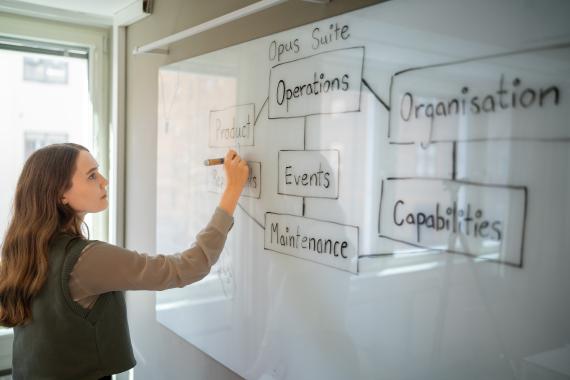
Whether open pit or underground, the construction phase of a mine involves decisions that are difficult or financially unjustifiable to reverse once made. Mining technique, investment in production tools and machinery, crushers and concentrators for processing, and the logistics linking the mine to the smelters should all be decided from a life cycle perspective, because each one commits cost and performance for the life of the operation. Opus Suite+, which unifies optimization, simulation and LCC cost analysis, is built to balance long term system performance against LCC at exactly this stage, giving operators a quantified view of the trade offs before they are locked in.
Systecon's track record in mining life cycle cost analysis
Systecon has worked across mining LCC projects ranging from a new main haulage level, to cost effective product shipping, to handbooks for applying LCC methodology within the mining industry. Across these projects, applying Life Cycle Management (LCM) and LCC analysis has consistently supported the right decisions, increasing business value and margin for customers.
Aftermarket support: spare parts optimisation and readiness for mining suppliers
For many mining suppliers, the aftermarket is a significant share of the business, and the ability to supply parts or maintenance with a short response time is what customers judge uptime on. Maintaining that readiness is expensive: it demands a well dimensioned spare parts assortment, efficient logistics, and maintenance teams on standby. Opus Suite+'s analytical capabilities help suppliers avoid tying up funds in excess inventory and streamline the supply chain, while ensuring customers get full value from their service contracts, creating a solution that benefits both supplier margin and customer readiness.
Frequently Asked Questions
What is life cycle cost (LCC) in mining?
Life Cycle Cost is the total cost of a mining asset or system across its full life, from initial investment through operation, maintenance and eventual replacement, not just the upfront capital cost.
Why is life cycle management important for mining projects?
Mining mega projects involve large, largely irreversible capital decisions and operate on low margins. Decisions concerning mining techniques, equipment and logistics therefore need to be evaluated based on their whole-life cost and performance impact, rather than construction cost alone.
How does Opus Suite+ support mining operations and aftermarket suppliers?
Systecon Attending IMARC 2026
Systecon will be at IMARC 2026 in Sydney, October 27 to 29, connecting with mine owners, operators, and technology leaders from across the global mining value chain.
If your organization is working through fleet, haulage, or major equipment decisions, our team can walk you through how life cycle cost (LCC) analysis has helped mining operators like LKAB LKAB make a multi decade infrastructure call with confidence, choosing the most cost-effective transport solution for a major mine expansion.
To set up time onsite, connect with Andrew Perkins.
Proven in the Field: LKAB Kiruna Mine Expansion
Evaluation of Means of Transportation in Mines
Learn how Systecon and Opus Suite analyzed the cost-effectiveness of different mine transportation alternatives using life cycle cost (LCC) analysis. When LKAB needed to choose between rail, truck, and hybrid transport for the new main haulage level at its Kiruna mine, the results pointed clearly to rail, a decision that held up even under sensitivity testing. See how this LCC methodology helped LKAB make a multi-decade infrastructure call with confidence.
View the Case Study

Find out more about the decision support Opus Suite can provide to your organization.