What is Life Cycle Management Software?
Life cycle management software refers to digital tools that enable organisations to plan, analyse, and optimise total cost of ownership, operational availability, and system performance across decades of service. These applications transform static spreadsheets and fragmented data into dynamic, evidence-based decision support that spans design, operations, and sustainment.
Modern LCM software models three interrelated domains simultaneously: the technical design, the operational concept, and the support system design. The result is the ability to predict the true consequences of decisions before they are made, then optimise across cost, availability, and performance as a unified framework.
Why Life Cycle Management Matters
The economic reality is stark. Operation and support costs account for 60–70% of total lifecycle cost, yet procurement decisions dominate budgets and attention. Early choices about design, maintenance concepts, sparing strategy, and repair locations cascade through decades of service.
Without LCM discipline, programs risk:
- Underestimating the true cost of ownership by 30–50%.
- Missing availability and readiness targets in-service.
- Creating unsustainable logistics footprints.
- Committing to support models that cannot adapt.
With the right software and analytical approach, decision-makers can model these consequences before systems enter service, ensuring they remain affordable, available, and mission-ready over the long term.
From Static Analysis to Dynamic Modelling
Historically, LCM analysis relied on spreadsheets, point calculations, and siloed data. Each function—engineering, procurement, logistics, operations—worked from incomplete pictures. Trade-offs between cost, weight, and performance were evaluated manually, often without visibility into how a design change rippled through the support chain.
Modern LCM software changes this fundamentally. By integrating technical data, operational scenarios, logistics constraints, and cost models in one platform, organizations can now:
- Run scenario analysis. Model how different design choices, maintenance strategies, or operational tempos affect availability and cost.
- Compare alternatives at scale. Evaluate hundreds of combinations and find the genuinely optimal solution, not the best one that fits a spreadsheet.
- Validate targets before commitment. Test whether an availability target is achievable within your logistics footprint and budget.
- Build shared models. Operators, suppliers, and engineers work from one agreed source of truth, not competing estimates.
- Update continuously. Feed in-service data to refine models, enabling faster adaptation as conditions change.
The Three Domains of LCM Optimisation
Technical System Design
The inherent reliability and maintainability of equipment—how often it fails, how long it takes to repair, what it weighs, how it consumes power—are locked in during design. These characteristics determine the floor on what operational availability is physically possible, regardless of how well-resourced the support chain is.
LCM software helps design teams understand the support implications of every choice. A more reliable component costs more upfront but reduces lifecycle cost. A heavier system improves performance but limits deployability. A simpler design speeds maintenance but constrains capability. These trade-offs must be quantified before the design is finalized.
Key design-phase capabilities:
- Reliability, Availability, and Maintainability (RAMS) modelling. Predicts operational availability based on component reliability, repair times, and logistics delay.
- Trade-off analysis. Models the lifecycle cost impact of performance, weight, and supportability changes.
- Obsolescence forecasting. Identifies components at risk of supply discontinuation and evaluates redesign alternatives.
Operational Concept
How often the system is used, how intensively, what surge demands it faces, and what geographic dispersion it operates across—these define the operational context. The same system will have radically different support requirements depending on whether it operates in garrison, deploys regionally, or sustains global presence.
Operational availability (Ao)—the real-world uptime—is determined jointly by the equipment's inherent reliability and the responsiveness of the support chain to maintain it. A highly reliable system with slow spares delivery can have poor operational availability. A less reliable system with rapid repair and part replacement can exceed expectations.
LCM software models this interdependence, showing how different operational tempos, deployment patterns, and surge scenarios drive support resource requirements and cost.
Key operational-phase capabilities:
- Logistics simulation. Models the effect of repair-level decisions, spares locations, transportation times, and workforce availability on operational readiness.
- Availability prediction. Validates whether a target operational availability is achievable under specified operational conditions.
- Surge capacity analysis. Evaluates how the support system performs under peak demand.
Support System Design
The support system—where repair happens, how spares are held, which parts are repaired versus replaced, how technicians are trained and distributed, what tools and test equipment are needed—is as much a design choice as the technical system itself.
Optimizing support is the highest-leverage decision in LCM. Moving from high repair depth (fix everything locally) to managed repair levels (send subassemblies to depot) can reduce spares holdings by 20–30% while maintaining or improving availability. Consolidating spares locations can reduce inventory without impairing responsiveness. Preventive maintenance optimisation can cut unplanned failures and their associated logistics costs.
The key constraint: support must be sized not for average demand, but for peak demand—or the system becomes undeployable when needed most.
Key support-phase capabilities:
- Maintenance concept optimisation (LORA). Determines the cost-optimal repair level for each item and where repair resources should be located.
- Spare parts optimisation. Calculates the exact range and depth of spares needed to meet a target availability at minimum cost.
- Lifecycle cost modelling. Quantifies the full cost to operate and maintain the system across its service life, including depot operations, training, technical data, and support infrastructure.
- Availability-cost trade-off. Shows the actual cost of moving from 90% to 95% availability, or from 95% to 99%. Not all improvements are economically justified.
LCM Software Across the Lifecycle
The value of evidence-based LCM analysis grows at every phase:
- Concept and Design. Model the support implications of design choices before they are finalized. A change made here costs nothing; the same change in-service costs millions.
- Procurement. Evaluate suppliers not on acquisition price alone, but on the total lifecycle cost of their offering. Negotiate performance-based contracts backed by quantified availability and cost models both parties trust.
- Test and Evaluation. Validate support assumptions in simulated operational environments. Identify shortfalls before systems deploy.
- In-Service Support. Feed actual operational data into the model. Refine availability predictions, update cost forecasts, and identify where the support system can be optimized without compromising readiness.
- Upgrades and Life Extension.** Before inserting new technology or extending service life, model the impact on support requirements and lifecycle cost. Technology insertion is not cost-neutral.
Standards and Frameworks Underpinning LCM
Modern LCM software operates within recognized standards and defence acquisition frameworks:
- Defence Standard 00-600 (UK MOD). Integrated Logistic Support requirements for MOD projects.
- S3000L (NATO/international). Logistics Support Analysis—the analytical process for optimising design for supportability.
- S4000P (NATO/international). Scheduled Maintenance and In-Service Maintenance Optimisation (ISMO).
- ASOE Model (US DoD). Affordable System Operational Effectiveness—the framework showing how technical performance, availability, cost, and operational effectiveness are interdependent.
- CADMID (UK). The defence lifecycle framework (Concept, Assessment, Demonstration, Manufacture, In-service, Disposal).
- Integrated Product Support (IPS) (US DoD) / Integrated Logistics Support (ILS) (UK/NATO). The overarching frameworks for planning all 12 elements of product support.
The Systecon Advantage
Systecon has spent over 50 years helping defence forces and industry partners optimize cost, readiness, and performance through advanced decision-support tools.
Our Opus Suite+ platform is the modern evolution of proven Opus Suite tools, consolidating optimisation, simulation, and lifecycle cost analysis into a single unified environment. It enables organizations to model all three domains simultaneously and find the genuinely optimal support solution.
Optimisation. Precisely optimizes spare parts and maintenance concepts for minimum cost and maximum readiness. Determines where to repair, what to stock, and how deep spares holdings must be.
Simulation. Simulates operations under real-world conditions—geographic dispersion, repair delays, surge demand, logistics constraints. Validates availability targets and identifies support system bottlenecks before they become operational problems.
Lifecycle Cost Analysis. Delivers precise lifecycle cost analysis, including all elements of operation and support from initial deployment to end of life. Enables comparison of support alternatives on quantified cost, benefit, and risk.
By embedding these capabilities within an IPS / ILS framework, Systecon helps organizations make data-driven, lifecycle-focused decisions that keep systems mission-ready at the lowest achievable cost.
Frequently Asked Questions
What is LCM software and why do organisations need it?
Life cycle management software is a decision-support tool that helps organisations model, analyse, and optimise system cost, performance, and availability across the entire lifecycle—typically 10 to 50 years.
Unlike spreadsheets or disconnected point tools, LCM software integrates technical design data, operational scenarios, logistics constraints, and cost models in a single environment. Organisations need it because operation and support costs account for 60–70% of total lifecycle cost, yet most budgets and decisions are made based on acquisition price alone.
LCM software corrects this by showing the true, long-term consequences of early design and support decisions. Opus Suite+ consolidates optimisation, simulation, and lifecycle cost analysis into one unified platform designed for this exact purpose.
What problems does life cycle management software solve?
LCM software solves five core problems. First, it eliminates fragmented analysis—the need to reconcile data across multiple spreadsheets and tools.
Second, it enables defensible decisions by quantifying trade-offs between cost, availability, and performance before commitments are locked in. Third, it identifies support system bottlenecks early, when changes are cheap. Fourth, it reduces lifecycle cost by optimising spare parts, maintenance concepts, and repair locations simultaneously.
Fifth, it enables performance-based contracts by providing both operator and supplier with a shared, trusted model of what's achievable. Opus Suite+ addresses all five by bringing optimisation, simulation, and cost analysis together in one integrated environment.
What industries use life cycle management software?
LCM software is essential in defence and aerospace, where systems operate for 20–50 years and lifecycle costs dwarf acquisition costs. The majority of NATO defence forces use LCM tools.
Commercial users include energy utilities, railways, shipping, and other asset-intensive industries where long-term affordability and operational readiness drive business decisions. Any organisation managing complex, mission-critical systems with long service lives and high downtime costs is a candidate for LCM software.
How does LCM software reduce lifecycle cost?
LCM software reduces lifecycle cost by optimising three interdependent domains.
First, technical design: it quantifies the support implications of design choices and identifies where reliability improvements are cost-justified. Second, operational concept: it models how different operational tempos, deployment patterns, and surge scenarios drive support resource requirements.
Third, support system design: it determines the cost-optimal repair levels, spare parts holdings, and logistics footprints. By optimising all three simultaneously, organisations can typically reduce spares holdings by 20–30% while maintaining or improving availability—directly lowering O&S costs.
Opus Suite+ models all three domains in one environment, eliminating the manual reconciliation that wastes time and introduces error.
What is the difference between inherent and operational availability?
Inherent availability (Ai) is a design characteristic—how often equipment fails and how quickly it can be repaired—and is determined solely by the technical system.
Operational availability (Ao) is the real-world uptime, including logistics delays, time waiting for spares, and administrative delays. Ao is always lower than Ai and is governed by the support chain.
A highly reliable system with slow spares delivery can have poor operational availability. LCM software models this gap and shows how to close it through support system optimisation.
What is LORA and how does it affect lifecycle cost?
LORA (Level of Repair Analysis, or Maintenance Concept Optimisation) determines where equipment should be repaired—at the operating unit, at an intermediate depot, or at a central facility.
This seemingly simple choice has massive cost implications. Moving from high repair depth to managed repair levels can reduce spares holdings by 20–30%, cut training burden, and lower total support cost.
LORA analysis must account for geographic dispersion, repair times, transportation costs, and staffing. LCM software automates LORA, evaluating hundreds of combinations to find the optimal repair strategy.
Opus Suite+ provides optimisation capabilities specifically designed for large-scale LORA, handling complex systems with hundreds of components across multiple locations.
How does LCM software optimise spare parts?
Spare parts optimisation calculates the exact range and depth of spares needed to meet a target operational availability at minimum cost.
It considers component reliability, repair times, logistics delay, geographic distribution, and surge demand. The result is a precise sparing plan that avoids both stockouts, which cause downtime, and overstocking, which wastes money.
Optimisation can reduce inventory 20–30% versus traditional methods while improving availability. Opus Suite+ delivers precise spare parts recommendations, ensuring the right stock is in the right place at the lowest possible cost.
What standards govern life cycle management?
LCM is governed by recognised defence and international standards. In the UK, Defence Standard 00-600 mandates Integrated Logistic Support (ILS) for MOD projects.
NATO and international standards include S3000L (Logistics Support Analysis), S4000P (Scheduled Maintenance), and S2000M (Provisioning). In the US, the ASOE Model (Affordable System Operational Effectiveness) and IPS (Integrated Product Support) are the frameworks.
Modern LCM software is built to align with these standards, ensuring analyses are defensible in acquisition and sustainment reviews.
How does LCM software support performance-based contracts?
Performance-based logistics (PBL) contracts commit suppliers to specific availability or readiness targets rather than selling parts and repairs as transactions.
These contracts require both operator and supplier to trust a shared model of what's achievable. LCM software provides that foundation by modelling the interaction between technical design, operational scenario, and support system.
With this evidence, contracts can specify genuine, achievable targets backed by quantified assumptions rather than guesswork or supplier claims. Opus Suite+ enables both parties to build shared models, align on assumptions, and negotiate realistic, mutually achievable performance targets.
What is the ROI of implementing LCM software?
ROI varies by system complexity and lifecycle length. For complex systems with 20–50 year service lives, typical returns include 20–30% reductions in spare parts inventory, 15–25% reductions in support labour, and accurate lifecycle cost forecasts.
On large defence programmes, savings often run to hundreds of millions. Break-even typically occurs within the first 2–3 years of operation.
The largest returns come from early adoption—decisions made during design are exponentially cheaper to implement than late-stage changes.
How does LCM software integrate with existing systems?
Modern LCM software integrates with data sources including logistics databases, engineering tools, cost management systems, and S3000L-compliant LSA (Logistics Support Analysis) databases.
Integration typically happens via standard connectors or APIs, reducing manual data entry and reconciliation. Cloud-based LCM platforms enable team collaboration without local installation, while maintaining security and control over proprietary data.
Integration capabilities vary, so organisations should evaluate platforms on connector breadth and API flexibility.
Can LCM software model obsolescence risk?
Yes. Obsolescence—the risk that components will go out of production—is a major cost and availability driver for long-lifecycle systems.
LCM software can model component obsolescence risk based on estimated production end-of-life dates, identify which components are at risk, and evaluate mitigation strategies such as redesign, design-in alternatives, advance procurement, or planned technology insertion.
Opus Suite+ enables organisations to identify obsolescence risks early and model the cost impact of different mitigation strategies before they become operational problems.
How long does it take to build an LCM model?
Model build time depends on system complexity and data availability. Simple systems can be modelled in weeks; complex systems with hundreds of components and multiple operational scenarios may take months.
Modern LCM software with AI-assisted modelling and data integration connectors accelerates this process significantly. Once built, models are maintained and updated across the system lifecycle, using actual operational data to refine availability and cost predictions.
Opus Suite+ includes AI-assisted modelling and standard data connectors to accelerate model creation and reduce manual setup effort.
What training is needed to use LCM software?
LCM software is designed for logistics engineers, ILS leads, programme managers, and procurement professionals—people who understand systems engineering, supply chains, and acquisition.
Basic training covering platform navigation and model setup takes days. Advanced training covering scenario analysis and optimisation interpretation takes weeks.
Expert practitioners typically have backgrounds in logistics, engineering, or acquisition. Most modern LCM software platforms include training, documentation, and support to help teams become productive quickly.
Related Articles
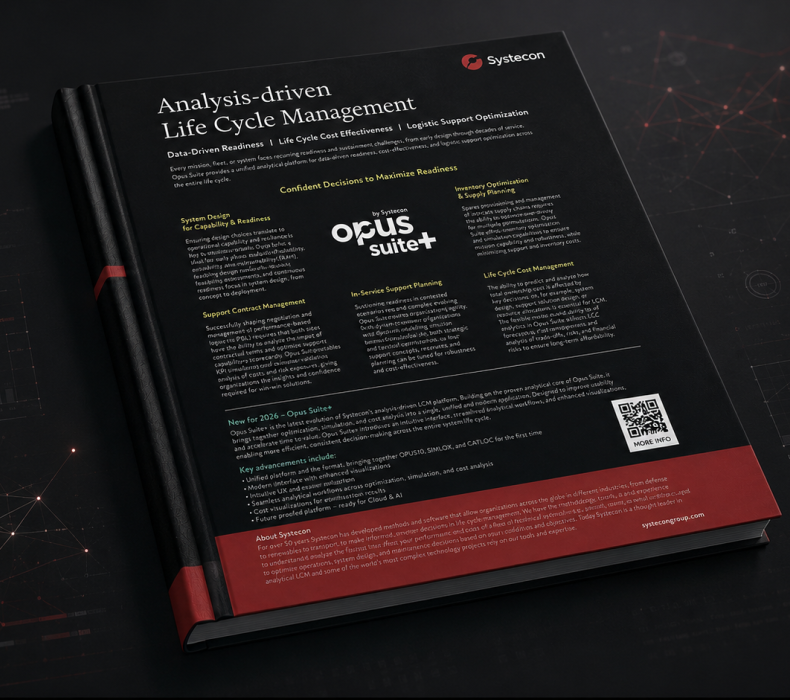
Discover The Latest Release of Opus Suite+
Opus Suite+ unifies the proven capabilities of OPUS10, SIMLOX, and CATLOC in a single modern platform, delivering fast, accurate analysis, optimization, and simulation across your system’s entire life cycle. Download the product overview to find out more.
Now with its second release, Opus Suite+ is not only a full replacement for OPUS10 and SIMLOX – it takes a significant step beyond.