OPUS10 – More than Spare Parts Optimization
To US defense and aerospace organizations, OPUS10 – one of the software tools in Opus Suite – is the standard for cost-effective, readiness-based sparing across DoD programs. Trusted by Lockheed Martin, the US Army, and major prime contractors, OPUS10 delivers realistic modeling of technical systems and support solutions, with rapid calculations that reduce spare part investment by 30% or more while increasing system availability. Used across Army, Navy, Air Force, and Marine Corps sustainment programs, it has become the tool of record for organizations that need to meet MIL-STD requirements and DoD readiness targets – without overinvesting in inventory.
Spare Parts Optimization for DoD Programs
OPUS10 is the primary tool used by US defense contractors and military program offices to answer the hardest sparing questions across complex multi-echelon supply chains. For organizations operating under readiness-based sparing requirements – from LSAR-driven procurement to PBL contract performance – OPUS10 provides the analytical foundation to meet targets at minimum cost.
OPUS10 is ideal for finding the most cost-effective answer to questions such as:
- What spare parts assortment should I stock, and how should I allocate it across depots, forward locations, and CONUS/OCONUS facilities to maximize readiness at lowest cost?
- My program has multiple readiness requirements that differ by unit, location, and system type. What is the most cost-effective assortment and allocation to meet them all?
- How should my spare parts solution be adjusted during a phased LRIP ramp-up or system phase-out under a DoD acquisition program?
- For each LRU or SRU, should it be repaired or condemned when it fails – and where in the supply chain should that repair occur?
- What will total spares investment cost against my contract availability target, factoring in DFARS cost constraints and performance-based logistics requirements?
How does my solution perform under demand surges, lead time variability, or supply chain disruption scenarios?
Evaluation of Support Solutions for US Sustainment Programs
Beyond sparing, OPUS10 provides decision support across the full maintenance concept for US defense programs. Program managers, logisticians, and system engineers use OPUS10 to evaluate and optimize support solutions under US sustainment frameworks – from depot-level maintenance allocation to organic vs. contractor logistics support (CLS) trade-offs.
- What is the most cost-effective support organization structure for this DoD program?
- Where in the maintenance hierarchy should repairs occur to minimize total ownership cost?
- Should all or part of the maintenance be performed organically or outsourced under a CLS or PBL arrangement?
- How many forward-positioned warehouses are required, and where should they be located to support operational requirements?
- What is the most cost effective transport solution?
- How sensitive is the support solution to changes in failure rates, lead times, or operational tempo?
- How should the support concept evolve as systems ramp up to full operational capability or begin phase-out?
Evaluation of Technical Systems and Acquisition Trade-offs
OPUS10 is used extensively in US defense acquisition to evaluate alternative system configurations and support solutions during the Engineering and Manufacturing Development (EMD) and Production and Deployment phases. It enables program offices and contractors to answer:
- Which system design or configuration delivers the best supportability performance from a life cycle cost perspective?
- What is the most cost-effective component choice when weighing higher unit cost against improved reliability and lower sustainment cost?
- Which component upgrades or design changes are worth the investment based on modeled improvement in availability or reduction in total cost of ownership?
Modeling and Optimization Across Complex DoD Scenarios
OPUS10 is scalable across the full range of US defense program complexity – from small fleet analysis to large multi-echelon, multi-site programs with thousands of components across CONUS and OCONUS locations. Its optimization algorithms produce results in seconds even for complex scenarios. OPUS10 accommodates:
- Repairable components, consumables, and mixed populations across multi-echelon supply chains
- Scheduled and unscheduled maintenance, including condition-based maintenance applications
- Time-phased scenarios such as LRIP ramp-up, deployment cycles, and phase-out planning
- Item-specific support solutions and program-specific criticality levels
- Multiple performance requirements per unit, location, or system type – aligned to DoD availability thresholds and objectives
OPUS10 and US Defense Programs: Frequently Asked Questions
Is OPUS10 used in U.S. Department of Defense programs?
Yes. OPUS10 is used by U.S. defense contractors and military program offices across all service branches, including Army, Navy, Air Force, and Marine Corps programs. It supports readiness-based sparing analysis, LSA data integration, and sustainment planning within DoD acquisition frameworks.
How does OPUS10 support DoD readiness-based sparing requirements?
OPUS10 is purpose-built for readiness-based sparing. It models multi-echelon supply chains against availability objectives and readiness thresholds, producing cost-optimized spare parts assortments that meet DoD readiness targets at minimum investment. This approach aligns with the principles of MIL-HDBK-502 and related sustainment policies.
Does OPUS10 integrate with U.S. military ERP and LSAR systems?
Yes. OPUS10 integrates with Logistic Support Analysis Record (LSAR) tools, ERP systems, and PLM platforms through Opus Suite Connect. It supports standard formats such as S3000L and GEIA-0007, as well as direct interfaces with tools including Raytheon EAGLE and ISS SLICwave.
Which U.S. defense contractors use OPUS10?
OPUS10 is used by major U.S. defense prime contractors, including Lockheed Martin and BAE Systems. It is also deployed by Systecon North America in support of government program offices and military customers across Army, Navy, and Air Force programs.
How does OPUS10 align with U.S. defense supply chain management frameworks?
OPUS10 is designed to support U.S. defense supply chain and acquisition frameworks. It enables analysis aligned with DoD logistics policy, FAR/DFARS sustainment requirements, Performance-Based Logistics (PBL) contracts, and Integrated Product Support (IPS) planning under DoDI 5000.91.
Previous versions release information
Upcoming courses
| Course | Date | Location | |
|---|---|---|---|
| OPUS10 & SIMLOX Basic Course | Virtual, North America | Learn more | |
| OPUS10 Basic Course | Bridgewater, UK | Learn more | |
| OPUS10 Extended Course | Stockholm, Sweden | Learn more | |
| OPUS10 Extended Course | Virtual, North America | Learn more | |
| OPUS10 & SIMLOX Basic Course | Virtual, North America | Learn more |
Quick tour
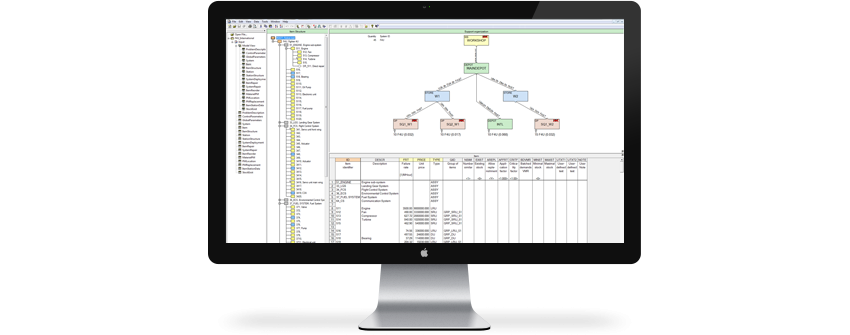
Data Input
The scenario to be analyzed is described in the OPUS10 model, which is based on tables that are used in a flexible way depending on for example complexity and desired level of detail. A “model view” gives the user overview and support when building the model, with a graphic representation of the technical system and its product structure, and the logistic support solution.
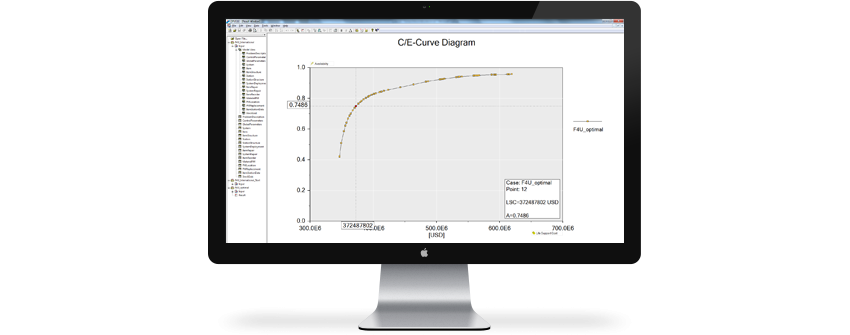
The C/E Curve
The Cost/Efficiency (C/E) Curve is a key step in the OPUS10 optimization. For the described scenario, a series of solution points is generated, showing maximum achievable system efficiency at different budgets. One solution point is selected based on efficiency requirements and/or budget. The optimized solution behind the point can the be examined in the Table view, the Analysis view or in the Reports. By generating C/E curves for different scenarios in the same graph, their cost efficiency can be compared side by side.
Table View
The OPUS10 Results View features an interactive table where you can easily select which solution points, parameters and dimensions to study. For instance, you can list stock levels, investments and service levels per component and location.
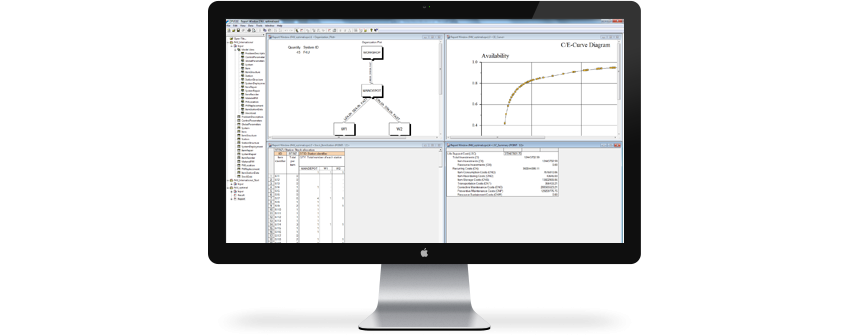
The Report Generator
OPUS10 report generator provides reports that can be customized to show the results that are of interest. There is a great number of result tables and fields to choose from. Reports are easily exported to MS Excel or external databases and ERP systems.