What Is Life Cycle Management Software? LCM vs PLM
Life cycle management (LCM) software is engineering software that models what it will take, and what it will cost, to keep a system available across its service life. Defense programs use it to set availability targets, size spares and repair capacity, and predict total life cycle cost before support decisions are locked in.
Life cycle management (LCM) software is engineering software that models what it will take, and what it will cost, to keep a system available across its service life. It brings reliability, maintenance, spares and cost data into one model so defense programs can compare support options before committing to them. Opus Suite+ is Systecon's life cycle management software for defense and industrial programs.
Life Cycle Management Software vs Product Life Cycle Management Software
The terms sound similar and are often used interchangeably, but they solve different problems. Product life cycle management (PLM) software manages what a product is: its design, configuration and engineering changes. Life cycle management software analyzes what it will take, and what it will cost, to keep that product available throughout its service life.
A third category, application lifecycle management (ALM), is used in software development and is unrelated to physical assets.
| Life cycle management (LCM) software | Product life cycle management (PLM) software | Application lifecycle management (ALM) software | |
|---|---|---|---|
| Core question | What will it take, and cost, to keep the system available in service? | What is the product, and how is it configured? | How is the software built, tested and released? |
| Typical users | Supportability engineers, ILS leads, logistics analysts, program managers | Design engineers, configuration managers | Software developers, QA teams |
| Main data | Reliability, maintenance tasks, spares, usage, life cycle cost | Parts, bills of materials, CAD, engineering changes | Code, requirements, test cases, releases |
| Key outputs | Operational availability, spares levels, repair-level decisions, life cycle cost | Controlled product definition and change history | Released software versions |
| Life cycle focus | In-service sustainment over decades | Design and production | Software development |
| Defense standards | ASD S3000L, GEIA-STD-0007, DoD IPS elements | Configuration management standards | Not applicable to physical assets |
How LCM Software Works With PLM Software
PLM and LCM software are complementary layers, not alternatives. PLM remains the authoritative source for the product structure and configuration. LCM software takes that data and combines it with:
- reliability and maintainability data
- logistics support analysis records (ASD S3000L and GEIA-STD-0007)
- cost and inventory data from ERP systems
From there it models how the system will perform and what it will cost to support in service. When a design changes in PLM, the impact on availability, spares and life cycle cost can be reassessed before the change is committed.
Opus Suite+ CONNECT integrates PLM, ERP and LSAR data sources directly, so analysis runs on current program data rather than manual exports and spreadsheets.
Why Life Cycle Management Matters
Operation and support account for the largest share of a defense system's total life cycle cost. Most of that cost is fixed by decisions made early in design and support planning. Life cycle management software lets programs test those decisions while they are still cheap to change.
From Static Analysis to Dynamic Modeling
Spreadsheet analysis gives a snapshot that ages as soon as the program changes. Life cycle management software keeps one integrated model that updates as design, usage and support data change. Programs can run scenarios, compare trade-offs and see the effect on availability and cost in the same place.
Three Domains of Life Cycle Optimization
LCM software optimizes three linked domains:
- Technical design: reliability targets, design trade-offs and obsolescence risk
- Operational concept: logistics simulation, availability and surge capacity
- Support system design: level of repair analysis (LORA), spares optimization and life cycle cost modeling
LCM Software Across the Program Life Cycle
The same model supports each phase of a program:
- Concept and requirements: sets realistic availability and cost targets
- Acquisition: compares bids and support solutions on total life cycle cost
- Test and evaluation: checks reliability and maintainability against the model
- In-service sustainment: tracks how well the support concept predicts operational availability against real data
- Upgrades and life extension: assesses the cost and readiness impact of changes
Standards That Govern Life Cycle Management
Life cycle management in defense follows established standards. For US programs the key references are GEIA-STD-0007 for logistics product data, ASD S3000L for logistics support analysis, and the DoD Integrated Product Support (IPS) elements.
How Opus Suite+ Supports Life Cycle Management
Opus Suite+ is Systecon's unified software solution for optimization, simulation and life cycle cost analysis. It combines capabilities previously delivered in OPUS10, SIMLOX and CATLOC, with life cycle costing now integrated into the same model.
Frequently Asked Questions About Life Cycle Management Software
What is life cycle management software?
Life cycle management (LCM) software models what it will take, and what it will cost, to keep a system available across its service life. It combines reliability, maintenance, spares and cost data so programs can compare support options before committing to them. Opus Suite+ is Systecon's LCM software for defense and industrial programs.
What is the difference between LCM and PLM software?
PLM software manages what a product is: its design, configuration and engineering changes. LCM software analyzes how that product will be supported in service, including availability, spares, maintenance and life cycle cost. PLM is the source of product data; LCM software uses that data to model sustainment.
Does life cycle management software replace PLM?
No. LCM software works alongside PLM. PLM stays the authoritative source for product structure and configuration, while LCM software adds reliability, logistics and cost data to model in-service performance. Opus Suite+ CONNECT links the two so design changes can be assessed for their effect on availability and cost.
Is life cycle management the same as application lifecycle management (ALM)?
No. Application lifecycle management (ALM) covers how software is planned, built, tested and released. Life cycle management software in defense deals with physical systems such as aircraft, ships and vehicles, and how to keep them available at the lowest life cycle cost.
Who uses life cycle management software?
Defense departments and agencies, prime contractors, fleet operators and sustainment program offices use LCM software. Typical users are supportability engineers, ILS leads, logistics analysts, life cycle cost analysts and program managers.
Which industries use life cycle management software?
Defense is the largest user, across air, naval and land systems. The same methods apply wherever complex, long-lived assets must stay available at controlled cost, including rail, mining and other heavy industry.
How does life cycle management software reduce life cycle cost?
LCM software tests support decisions before they are locked in. It optimizes spares levels, repair locations and maintenance concepts against an availability target, so programs buy the support they need and avoid paying for stock, facilities or labor that do not improve readiness.
What is the difference between inherent and operational availability?
Inherent availability reflects only the system's reliability and the time to repair it. Operational availability includes all real-world downtime, such as waiting for spares, transport and maintenance resources. LCM software models operational availability because it is what the end user actually experiences.
What is level of repair analysis (LORA)?
Level of repair analysis (LORA) determines whether a failed item should be repaired or discarded, and at which maintenance level. It balances repair cost against the cost of spares, test equipment and personnel across the system's life.
What is spares optimization?
Spares optimization calculates which spare parts to stock, how many, and where, to meet an availability target at the lowest cost. Opus Suite+ optimizes across multi-echelon support networks and multi-indenture equipment structures.
Which standards does life cycle management software support?
For US programs the key references are GEIA-STD-0007 for logistics product data, ASD S3000L for logistics support analysis, and the DoD Integrated Product Support (IPS) elements. LCM software uses data structured to these standards to build its models.
Can LCM software support performance-based logistics contracts?
Yes. Performance-based logistics (PBL) contracts pay for outcomes such as availability. LCM software models the availability a given support solution can deliver and what it will cost, so both sides can set realistic PBL metrics and price them with confidence.
Does LCM software integrate with existing systems?
Yes. Opus Suite+ CONNECT integrates PLM, ERP and LSAR data sources directly, so analysis runs on current program data rather than manual exports and spreadsheets.
How long does it take to build an LCM model?
Model build time depends on the size of the system and the quality of the available data. [VERIFY: add a typical range from product or services, or keep this answer general]
Is training available for life cycle management software?
Yes. Systecon runs courses in life cycle management methods and in using Opus Suite+. See life cycle management training courses.
Related Content
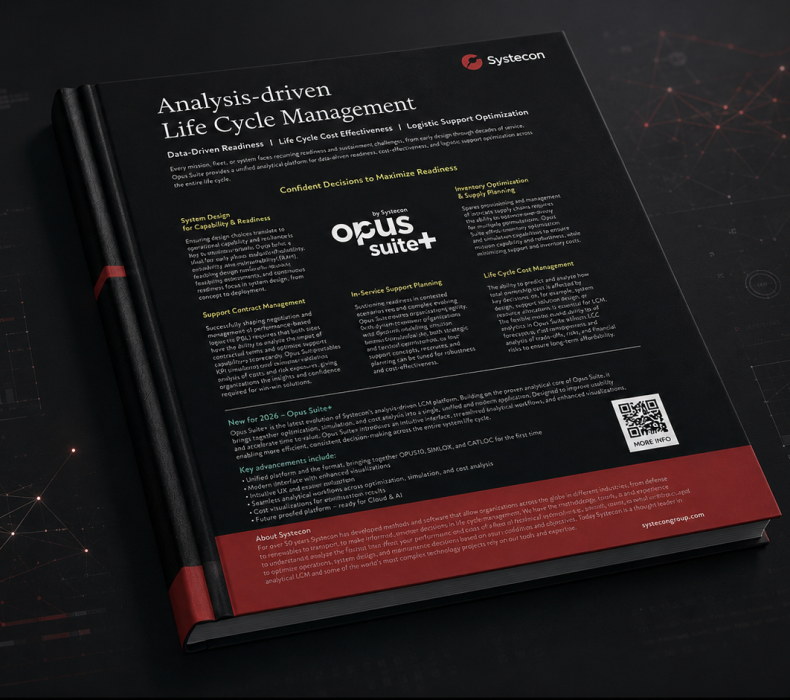
Discover The Latest Release of Opus Suite+
Opus Suite+ unifies the proven capabilities of OPUS10, SIMLOX, and CATLOC in a single modern platform, delivering fast, accurate analysis, optimization, and simulation across your system’s entire life cycle. Download the product overview to find out more.
Now with its second release, Opus Suite+ is not only a full replacement for OPUS10 and SIMLOX – it takes a significant step beyond.